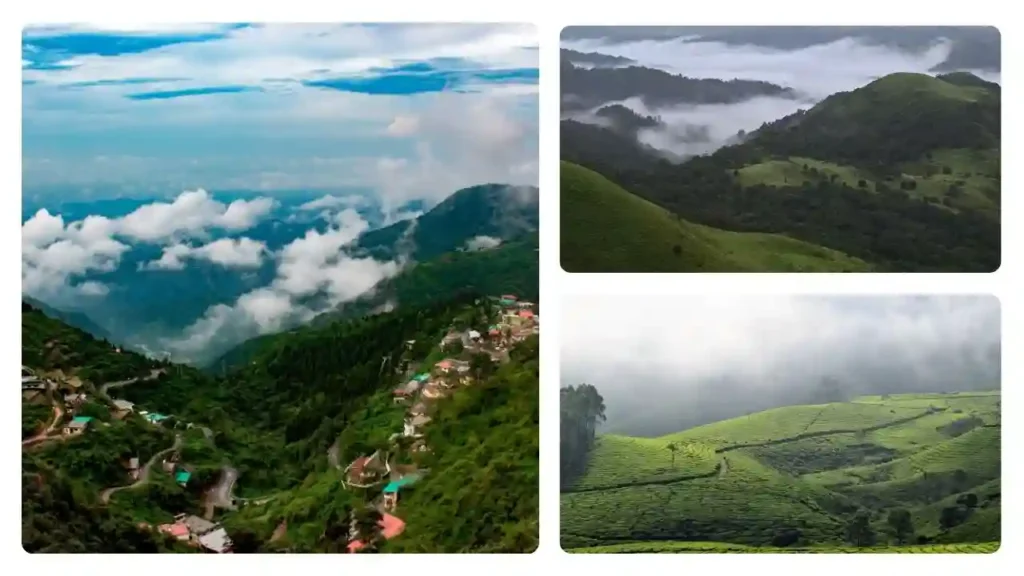
Imagine waking up, stepping onto your balcony, and looking down not at streets or gardens, but at a soft, rolling ocean of white mist. You aren’t in an airplane; you are standing on a mountain peak, watching the morning sun break over a sea of clouds floating beneath your feet.
In meteorology, this phenomenon is known as a temperature inversion. To wanderlust-smitten travelers, it is pure magic.
As slow travel and nature-focused getaways continue to dominate global travel trends, Indian hill stations are taking center stage. From the mist-shrouded Western Ghats to the dramatic peaks of the Himalayas, here are the top hill stations in India where you can literally walk above the clouds on your next trip.
1. Munnar, Kerala: The Emerald Sea of Fog
Nestled deep in Kerala’s Western Ghats, Munnar is famous for its endless rolling tea plantations. But visit early in the morning, and you’ll witness something extraordinary: entire valleys blanketed in dense, cotton-like fog.
- Where to experience the clouds: Head up to Kolukkumalai, the highest tea estate in the world. A bumpy 4×4 Jeep ride brings you to a vantage point that sits well above the cloud line. As the sun rises, the clouds glow gold right beneath your feet.
- Best Time to Visit: September to March.
- Traveler Tip: Book a local guide for an early morning 4:30 AM trek to catch the cloud inversion at its peak.
2. Cherrapunji & Shillong, Meghalaya: The Real “Abode of Clouds”
The state of Meghalaya literally translates to “The Abode of Clouds” in Sanskrit, and it certainly lives up to its name. Located in Northeast India, Shillong and its neighboring town, Cherrapunji, offer a landscape where clouds don’t just stay in the sky—they walk right into your hotel room.
- Where to experience the clouds: The Laitlum Canyons offer dramatic drop-offs into deep, mist-filled gorges. Stand at the edge of the canyon, and you will feel like you are standing on the edge of the earth, surrounded by a swirling sea of white mist.
- Best Time to Visit: October to April (for clear mountain views and gentle mist).
- Traveler Tip: Carry a light waterproof jacket; the weather changes from bright sun to heavy cloud cover in seconds.
3. Mussoorie, Uttarakhand: Home of the Floating Peaks
Perched in the foothills of the Garhwal Himalayan range, Mussoorie has long been dubbed the “Queen of the Hills.” Beyond its colonial charm, Mussoorie offers a rare atmospheric view where the Doon Valley below gets entirely swallowed by clouds, leaving only the mountain peaks visible.
- Where to experience the clouds: Visit Cloud’s End, a tranquil spot surrounded by thick oak and deodar forests. Another hotspot is Lal Tibba, the highest point in Mussoorie, where you can watch the cloud layer drift beneath the snow-capped Himalayan peaks.
- Best Time to Visit: September to November (ideal for clear winter lines and cloud views).
- Traveler Tip: Plan your visit around dusk to catch the rare “Winter Line” phenomenon, where the horizon turns shades of purple and orange above the clouds.
4. Coorg, Karnataka: Walking in the Mist of Coffee Country
Often referred to as the “Scotland of India,” Coorg (Madikeri) is a lush sanctuary of coffee plantations, cascading waterfalls, and misty mountain ranges. During the post-monsoon months, the valleys of Coorg turn into massive reservoirs of thick morning mist.
- Where to experience the clouds: Make your way up to Mandalpatti Peak. Accessible via an adventurous off-road drive, the summit rises above the surrounding hills, making you feel like you are standing on a cloud island in the sky.
- Best Time to Visit: October to February.
- Traveler Tip: Visit Mandalpatti before 7:00 AM. Once the sun heats up the valley, the cloud inversion begins to dissipate.
5. Chikmagalur, Karnataka: Touched by the Sky
Located just a few hours from Coorg, Chikmagalur is home to the highest peak in Karnataka—Mullayanagiri. Standing at nearly 6,300 feet, this peak regularly sits high above the low-hanging cloud decks.
- Where to experience the clouds: Trek or drive up to Mullayanagiri Peak or the nearby Baba Budangiri range. As you climb the narrow stone steps to the summit, you will literally walk through thick clouds before breaking out into bright sunshine at the top.
- Best Time to Visit: September to March.
- Traveler Tip: The winds at the summit can be extremely strong and cold, so bring a good windbreaker jacket.
Travel Insight Global’s Quick Guide: How to Capture “Cloud Inversions”
If you are traveling specifically to see clouds beneath your feet, keep these expert tips in mind:
- Timing is Everything: Cloud inversions almost always occur in the early morning (between dawn and 8:00 AM) when cold air is trapped in the valley beneath a layer of warm air.
- Post-Monsoon is Gold: The months immediately following the monsoon season (September to November) offer the highest moisture levels, creating the thickest and most dramatic cloud beds.
- Stay High: Book accommodation located at higher elevations rather than in the valley towns to wake up directly above the mist layer.
Final Thoughts
You don’t need an expensive long-haul flight to Europe or South America to witness world-class natural wonder. India’s diverse topography offers some of the most accessible and spellbinding “above-the-cloud” views on the planet.
Are you ready to walk on air? Pack your bags, set an early alarm, and get ready to experience the quiet majesty of clouds beneath your feet.