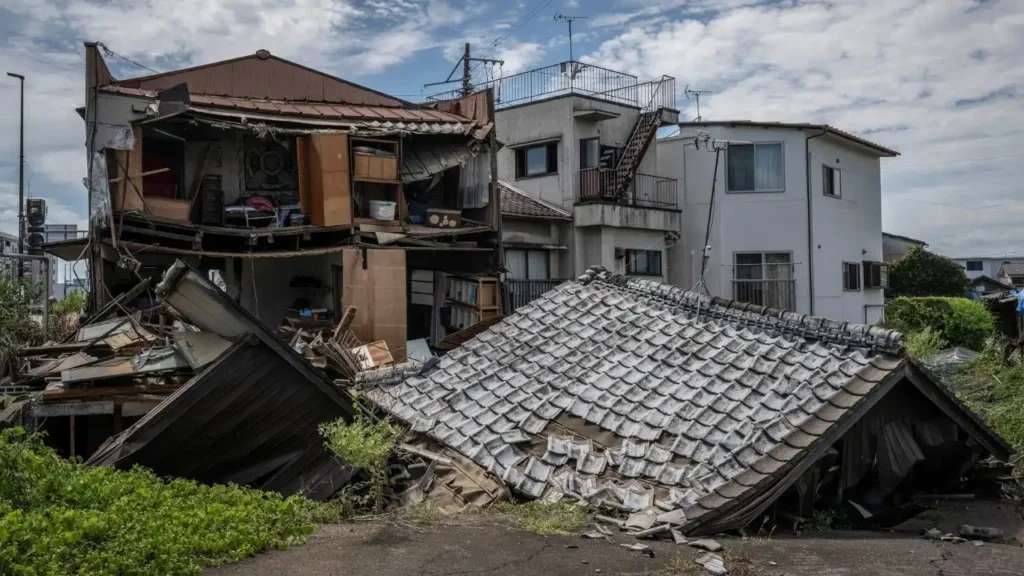
A powerful earthquake tore through southern Japan this week, killing at least 18 people, injuring dozens more, and leaving rescue crews racing against time inside a partially collapsed shopping mall.
What Happened
The quake struck Kumamoto prefecture on the island of Kyushu at around 4:30pm local time on Tuesday, July 28. It was initially measured at magnitude 7.1, though the US Geological Survey later revised it down to 6.8. A tsunami advisory went out within minutes but was lifted soon after.
The epicenter sat about 20km south of Kumamoto City, home to roughly 700,000 people. In the 24 hours that followed, the region shook through nearly 190 aftershocks, keeping residents on edge and complicating rescue work.
Inside the Collapsed Mall
The worst damage happened at the Aeon Mall in Kashima, a shopping center packed with thousands of customers when the ground started moving. Staff evacuated around 3,000 shoppers to the parking lot, but a gas explosion then tore through another section of the building where workers remained. The mall’s second floor gave way, trapping people inside.
Eight people were later pulled from the rubble, though four of them didn’t survive. Of the mall’s roughly 2,700 staff, three workers remain unaccounted for.
A Growing Toll Across the Region
The damage stretched well beyond the mall:
- A chimney collapse at a Nippon Paper Industries factory in Yatsushiro killed five workers; four more were still believed trapped.
- A Vietnamese technical intern died after a crane fell on him at his workplace — the first confirmed foreign national killed in the quake.
- Parts of Kumamoto Castle’s historic stone walls, still under repair from a devastating 2016 earthquake, collapsed again.
- Roads cracked and buckled across the prefecture, and nearly 35,000 homes lost power while 15,000 lost running water.
At least 62 people were injured, six of them seriously. Officials warned the death toll could keep climbing as search efforts continue in the sweltering summer heat.
Japan’s Response
Prime Minister Sanae Takaichi is leading the country’s emergency task force and called the rescue effort “a race against time.” Hundreds of soldiers joined firefighters and police in the search, while around 260,000 residents were told to move to evacuation centers.
Officials confirmed no abnormalities at the nearby Sendai Nuclear Power Plant, easing fears of a wider disaster.
Why This Region Keeps Shaking
Japan sits on the Pacific “Ring of Fire” and experiences roughly 20% of the world’s magnitude-6.0-plus earthquakes. Kumamoto has been here before — a 2016 quake in the same region killed 275 people and heavily damaged thousands of buildings, including the same castle walls that crumbled again this week.
This is a developing story. Figures including the death toll and number of missing may continue to change as rescue operations proceed.